
Metalized vs. Non-Metalized Film: Which Barrier Is Right for Your Product?
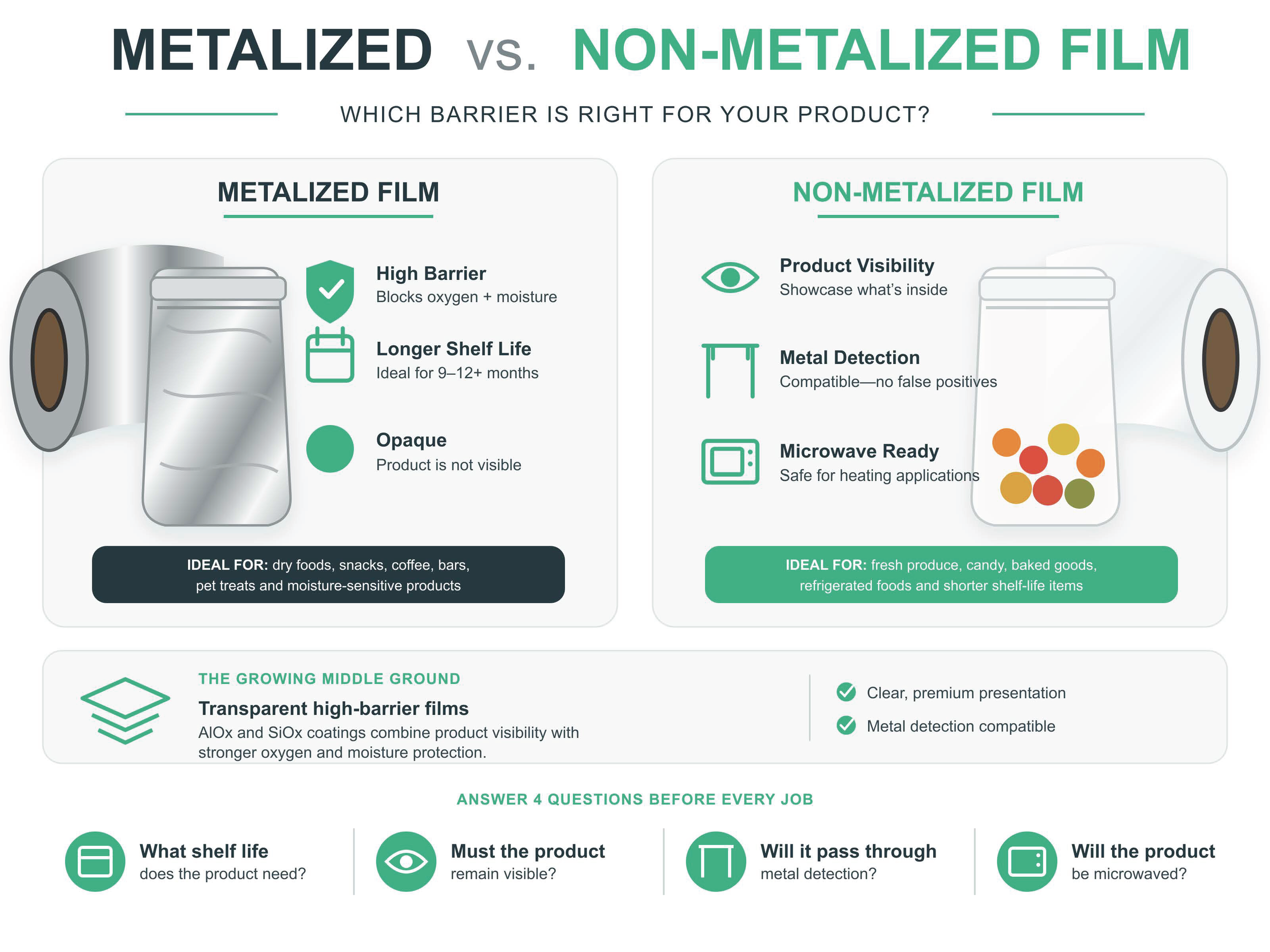
At Josh Packaging, one of the most common questions we get before a job is quoted involves barrier film: does this product need a metalized structure, or will a standard non-metalized film do the job? It is a question worth answering early. A structure change after production begins is expensive. Getting the specification right before a job goes to press is what keeps schedules and budgets intact. We have been building flexible packaging structures for over 35 years. Our complimentary consultation process covers this decision before any job is quoted. This article walks through how both options work and when each one applies.
What Metalized Film Does
Metalized film starts as a standard flexible substrate, most commonly PET or polypropylene, with an extremely thin layer of aluminum deposited onto its surface. That aluminum layer, though a fraction of the thickness of solid foil, dramatically reduces how much oxygen and moisture pass through the film.
The performance difference is significant. Plain polypropylene film allows substantial oxygen and moisture transmission. The metalized version cuts that transmission by roughly 98 percent. That level of barrier protection is why metalized film became the standard for snack packaging, coffee, nutrition bars, pet treats, and most dry foods where oxygen and moisture are the primary deterioration risks.
For products that need a nine to twelve-month shelf life under standard storage conditions, a metalized structure is often what makes the business case work. It delivers performance close to solid foil at a lower material cost and lighter weight.
When a Non-Metalized Structure Is the Right Call
Non-metalized film is not a lesser option. For a specific set of product categories, it is the correct engineering choice. Four scenarios drive that decision.
Product visibility: Fresh produce, candy, baked goods, and certain snack formats depend on the consumer seeing the product before purchase. Metalized film makes that impossible. Standard transparent film structures deliver adequate barrier performance for products with shorter shelf life requirements or refrigerated distribution, while keeping the product fully visible.
Metal detection requirements: Some retailers and food manufacturers require in-line metal detection at the fill line or in the distribution center. Metalized film triggers false positives in that equipment. If a customer's supply chain includes mandatory metal detection, a non-metalized structure is the specification that keeps the line running.
Microwave applications: Aluminum in metalized film reacts to microwave energy. Any product intended for microwave preparation in its packaging requires a non-metalized structure. That covers single-serve meals, steam bags, and ready-to-heat snack formats.
Shelf life target: A product with a 90-day shelf life under refrigerated storage does not need the same barrier level as an ambient-stored snack. Specifying metalized film for a product that does not require it adds cost without adding performance. We work through this calculation with customers during consultation, before the job is quoted.
Transparent High-Barrier Options: A Growing Middle Ground
A significant portion of flexible packaging innovation right now is focused on one specific problem: brands need strong barrier performance without the opacity, the metal detection issues, and the recyclability complications that metalized aluminum brings.
Aluminum oxide and silicon oxide coatings applied to standard film substrates are increasingly delivering barrier performance that approaches metalized film, while keeping the package fully transparent and metal-detection compatible. These structures carry a higher material cost, but they are the right specification for premium retail formats, certain produce and seafood categories, and any product routed through a supply chain with mandatory inline metal detection.
We carry aluminum oxide as a confirmed substrate option in our roll stock portfolio. Our team works through these emerging options with customers whose product requirements are at the edge of what standard structures can deliver.
The Four Questions We Work Through Before Every Job
Every barrier specification starts with the same questions, and we cover all of them before a structure goes to quotation.
What is the target shelf life, and under what storage conditions? A product stored at ambient temperature needs a different barrier than a product in refrigerated or frozen distribution. Knowing the actual storage conditions allows us to right-size the specification rather than over-engineer it.
Does the supply chain include metal detection? If yes, metalized film is eliminated as an option. The conversation moves to aluminum oxide coatings, standard transparent structures, or foil, depending on the barrier requirement.
Does the consumer need to see the product? Produce, candy, and certain fresh formats belong in transparent structures. The barrier requirement for those categories is typically lower than for shelf-stable snacks or coffee, which makes the transparency trade-off straightforward to resolve.
What happens to the package after filling? Hot-fill processes and microwave applications each have structural implications that need to be known before the specification is finalized. Discovering these downstream variables after the press run is an expensive way to find out.
Getting the Specification Right Before the Press Run
We print roughly 42,000 miles of roll stock per year across snacks, nuts, seafood, candy, frozen foods, agriculture, and produce. That volume means our team sees a wide enough range of applications to give informed guidance on what a given product actually needs, and what it does not.
We offer complimentary consultation with every inquiry. For a metalized versus non-metalized decision, that conversation typically takes 20 minutes and produces a structure specification that holds through production and shelf life validation. Our SQF and GMI certifications govern our production systems, and our Six Sigma processes are built to deliver 95 percent of jobs in as low as a two- to three-week lead time.
If your product is heading toward a packaging decision and the barrier question has not been fully resolved, contact us. That is exactly the conversation we are built for.